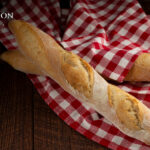
Baguette
Inspired by Clair Obscur: Expedition 33
Equipment
- Kitchen Scale, 1 Tall Jar, Large Bowl, Medium Bowl, Kitchen Scraper, Baker’s Couche, Baking Stone, Rimless Baking Sheet, Baguette Transfer Peel, Lame, Oven Safe Pan
Ingredients
Poolish
- 100 grams all-purpose flour
- 100 grams water room temp
- pinch of active dry yeast
Baguette
- 340 grams all-purpose flour
- 10 grams kosher salt
- 220 grams warm water
- poolish
- 4 grams active dry yeast
Instructions
Poolish
- Whisk together the ingredients for the poolish in a tall jar.
- Loosely cover and allow to rest at room temperature for 6 to 12 hours, or until it has doubled in size.
Baguette
- Combine the flour and salt in a medium bowl. Combine the warm water, poolish, and yeast in a large bowl and mix until the poolish dissolves.
- Add the flour mixture to the bowl and mix until it just comes together. The dough will be sticky and pretty loose at this point. Cover with a kitchen cloth and let rest for 30 minutes at room temperature.
- Wet your hands, uncover the dough, and lightly pull on the dough upward as far as it will let you. Fold it to the center and gently pat down. Repeat this around the entire dough. Flip over (smooth side facing up), cover, and rest for another 30 minutes at room temperature.
- Repeat step 3 twice more.
- After you have repeated this process 3 times, cover, and place in the refrigerator overnight, up to 24 hours.Note: I like to transfer mine into a square container (pictured above) that has capacity lines on it. This makes it a bit easier to track how much the dough has risen.
- The next day, remove the dough from the refrigerator and let it rest for 30 minutes, making sure the dough has doubled in size from yesterday.Note: The dough will likely have risen double in size during its rest time in the refrigerator. Still give the dough 30 minutes to warm up before working with it.
- Transfer the dough to a lightly floured work surface. Split into two equal portions (about 380 grams each). During this whole process make sure to keep your hands lightly floured because the dough will be very sticky.
- Take one of the portions and shape by tapping it into a rough 6-inch (15 cm) square. Make sure to pop any larger bubbles in the dough. Lightly stretch one of the sides and fold it to the center. Stretch the opposite side over and fold it over the center. The dough should now be a long rectangle shape.
- From the top, roll the dough toward you and over itself into a tight cylinder. Transfer to a lightly floured surface, seam-side down, and cover with a kitchen towel.
- Repeat steps 8 and 9 with the other portion.
- Let the dough rest for 15 to 20 minutes. While you wait, prepare the oven by placing the baking stone on the center rack of the oven. On a lower rack place a large oven safe pan. Preheat the oven to 500°F (260°C). Prepare the baker’s couch by generously dusting with flour, set aside.
- Once the dough has rested and looks a bit relaxed, lightly flour a work surface. Using a kitchen scraper, take one of the dough portions and transfer it to the lightly floured surface, seam side up.
- Lightly flour your hands, the dough is still very sticky and will easily stick to you. Lightly tap and shape into a rectangle, making sure to, once again, pop any large bubbles. The long edges of the rectangle should be the top and bottom parts.
- Take the top part of the dough and fold it into the center and press the dough to seal it.
- Rotate the dough 180° so the bottom edge is now the top. Take the new top and fold it to the center, creating a single seam with the previous fold in the center of the dough.
- Take the top edge of the dough and fold it, over the seam, to the bottom edge, use the base of your palm to seal it shut.
- At this point you should have a rough tube shaped dough. Place the seam side down on the work area. Using both your hands, lightly roll the dough out to 16 inch (40.5 cm) long, putting slightly more pressure at the ends to taper it off.
- Transfer to the prepared baker’s couche and place it seam-side up. Form a wall with the baker’s couche to help keep the dough’s shape as it rests.
- Repeat steps 12 through 18 with the other portion. Make sure to cover with the baker’s couche while the dough proofs.
- Proof the dough for 60 minutes, or until they’ve risen about 60%. Make sure during the proofing process, the dough is being supported by the baker’s couche so it doesn’t lose its shape.
- To test if the dough has proofed enough, flour a finger and poke the dough. If it pops back up immediately, it needs longer. Check back in 10 minutes. If it returns back slowly and a dimple remains, the dough is set.
- About 10 minutes before you are going to transfer these to the oven, bring 1 ½ cups of water to a boil. Also, prepare a rimless baking sheet with a large piece of parchment paper and sprinkle a bit of flour on top. Prepare the baguette transfer peel by coating generously with flour.
- Unwrap the baker’s couche, place the baguette transfer peel next to one of the loaves. Carefully, flip the loaf on to the peel so it is seam side down on the transfer peel.Note: If the loaf is stuck on the couche, lightly jiggle it to help it from unsticking from the couche.
- Carefully slide the loaf from the transfer peel onto the prepared parchment paper. Make sure the seam side is down.
- Repeat steps 23 through 24 with the other loaf.
- Lightly coat a lame with flour. Using a lame to score the baguettes 3 to 5 times.Note: Move quickly and confidentially with the lame when cutting. If you hesitate it will stick and not cut cleanly.
- Open the oven and carefully slide the parchment paper and loaves on top of the baking stone. Carefully, pull the rack with the pan below the baking stone, pour the boiling water into the pan, slide the rack back under, and shut the door. Bake for 10 minutes.Note: When pouring the water in the pan a lot of steam will come up. I highly recommend covering both hands with insulated kitchen gloves and to not put your head directly over the pan to avoid any burns.
- Reduce the heat to 450°F (232°C). Open the oven door for a couple of seconds to release any remaining steam in the oven. Bake for 10 to 15 minutes, or until the crust is golden brown. Remove the loaves by using a tong to remove them from the oven and transfer to a cooling rack. Allow the loaves to cool completely before cutting them.